Designing a Murphy Bed Worth Designing Around
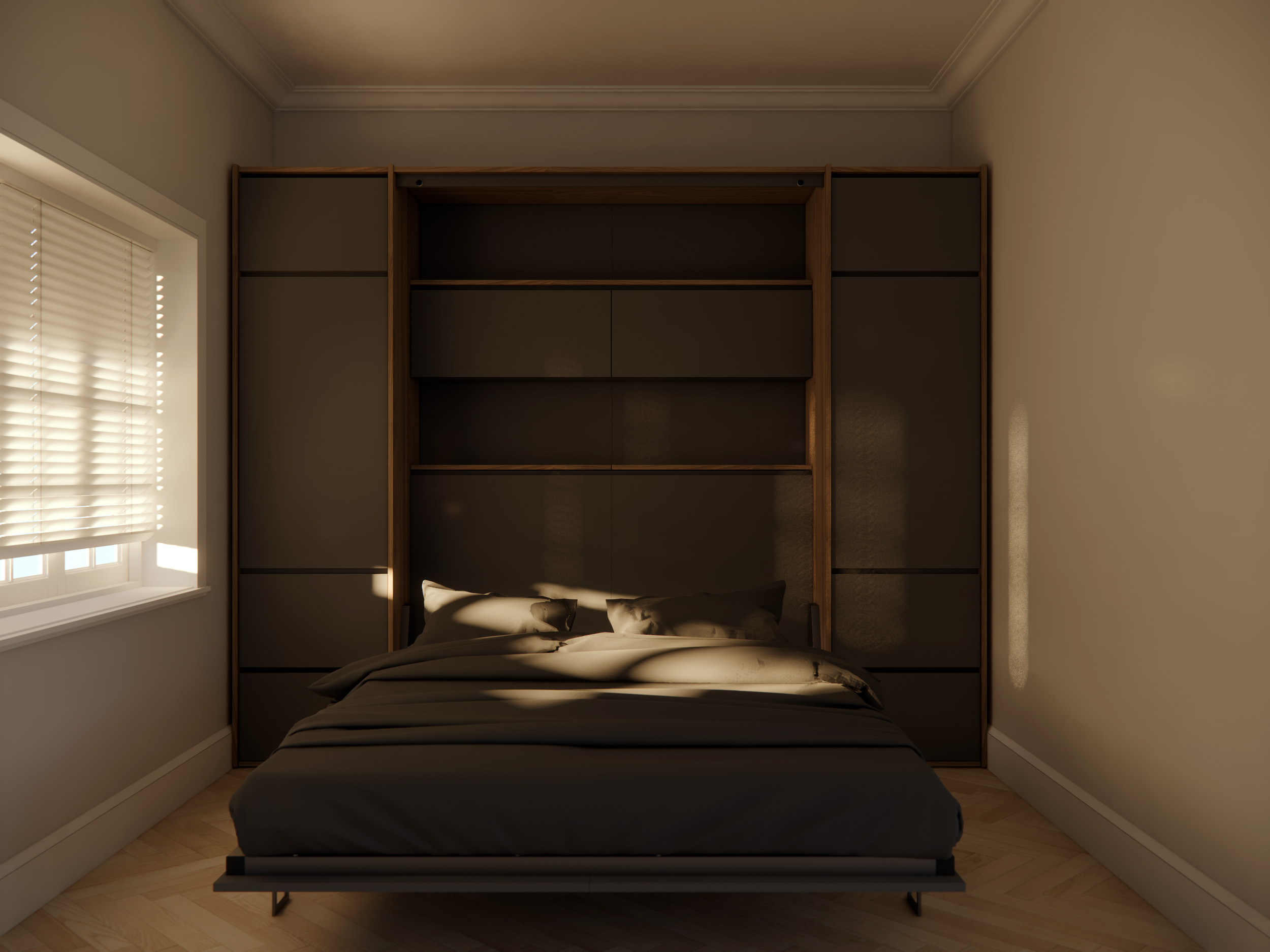
A long read on wall beds, the quiet square footage they return to a home, and the system that makes them more than a single piece of furniture.
What you actually gain when a bed disappears
A queen bed and its surrounding circulation take up roughly forty square feet of floor space. In a typical Vancouver condo, where every square foot now costs upward of $1,400, that bed is occupying somewhere in the neighbourhood of $55,000 worth of real estate. For most of every twenty-four hour day, that real estate is being used to hold a piece of furniture you are not actively using.
The wall bed inverts that math. When the bed is up, the room becomes a living room, a home office, a yoga studio, a place to entertain. When the bed is down, the room becomes a bedroom. The square footage is no longer dedicated. It is available - to whatever the moment requires.
This is not a small thing. In a market where homes have become smaller while their cost has grown, the wall bed is one of the few interventions that meaningfully changes the equation. It does not give you more square footage. It gives you back the square footage you already paid for.
This is especially significant for one-bedroom condos and studios, where the bedroom occupies a disproportionate share of the floor plate. But it matters in larger homes too. A guest room that holds a wall bed becomes a usable office, library, or den for the three hundred and fifty days a year no one is sleeping in it.
What separates a good wall bed from a bad one
There are perhaps a dozen things that distinguish a thoughtfully designed wall bed from a poorly designed one. Most of them are invisible until you live with the bed daily. A short list:
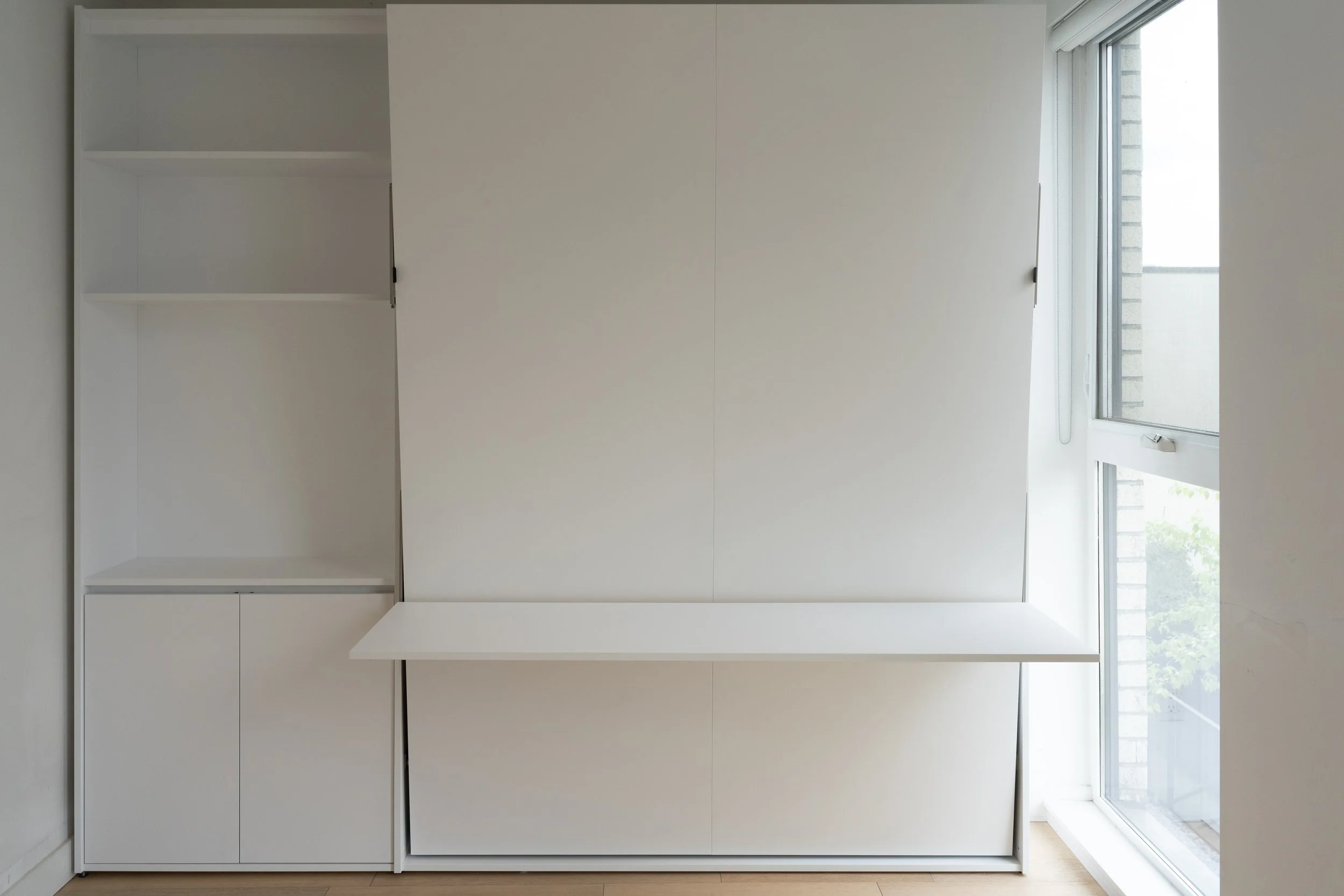
The mechanism. Cheap wall beds use spring-loaded mechanisms that wear out, sag, and become harder to operate over time. Quality wall beds use hydraulic struts calibrated precisely to the weight of the mattress. The Eddy bed pops open about six inches when first pulled, then pauses. A second small pull releases it, and the bed lowers itself - slowly, smoothly, under the calibrated control of the struts, until it lands softly on the floor. Five years in, it works exactly as it did the day it was installed.
The structure. A wall bed lives or dies on the integrity of its frame and its anchoring. Many wall beds rely on the cabinet itself to provide structural support, which means the cabinet has to be overbuilt and over-bulky to compensate. A wall bed designed to be anchored properly into the building's structural backing can have a more refined cabinet and last meaningfully longer.
The mattress thickness. The Tekka Eddy uses a 7" mattress, chosen as the precise balance between comfort and depth. Thick enough to be genuinely comfortable to sleep on every night. Thin enough that the closed wall bed sits at only 35cm deep against the wall. A thicker mattress would force a deeper cabinet for no meaningful gain in comfort. The 7" specification is not a compromise - it is the result of careful engineering against a real constraint.
The bedding. Quality wall beds are designed to hold the bedding in place while the bed is stored upright. The Eddy includes integrated straps that secure the sheets, duvet, and blankets through the day. You raise the bed in the morning without making it. You lower it at night and the bedding is exactly as you left it.
The fit and finish. Bad wall beds reveal themselves at the edges, visible gaps when closed, doors that do not quite line up, hardware that protrudes awkwardly. A wall bed designed with the same precision as architectural casework closes flush, sits flat against the wall, and disappears into the composition when not in use.
The wall bed as a piece of furniture versus the wall bed as part of a system
This is where the real conversation begins.
Most wall beds on the market today are sold as standalone furniture. You buy a wall bed cabinet. It comes in a fixed width, a fixed depth, and a small handful of finishes. You install it on a wall. The wall around it remains a wall.
This is a fine solution if all you need is a place to sleep when guests visit. It is a missed opportunity for almost everything else.
Because a wall bed is, structurally, a deep cabinet, and because the architectural conditions around it (a flat wall, sufficient ceiling height, room to deploy) are also the conditions ideal for built-in storage, integrated work surfaces, media walls, and shelving - the wall bed has the potential to anchor an entire wall composition. Not just to sit within it. To organize it.
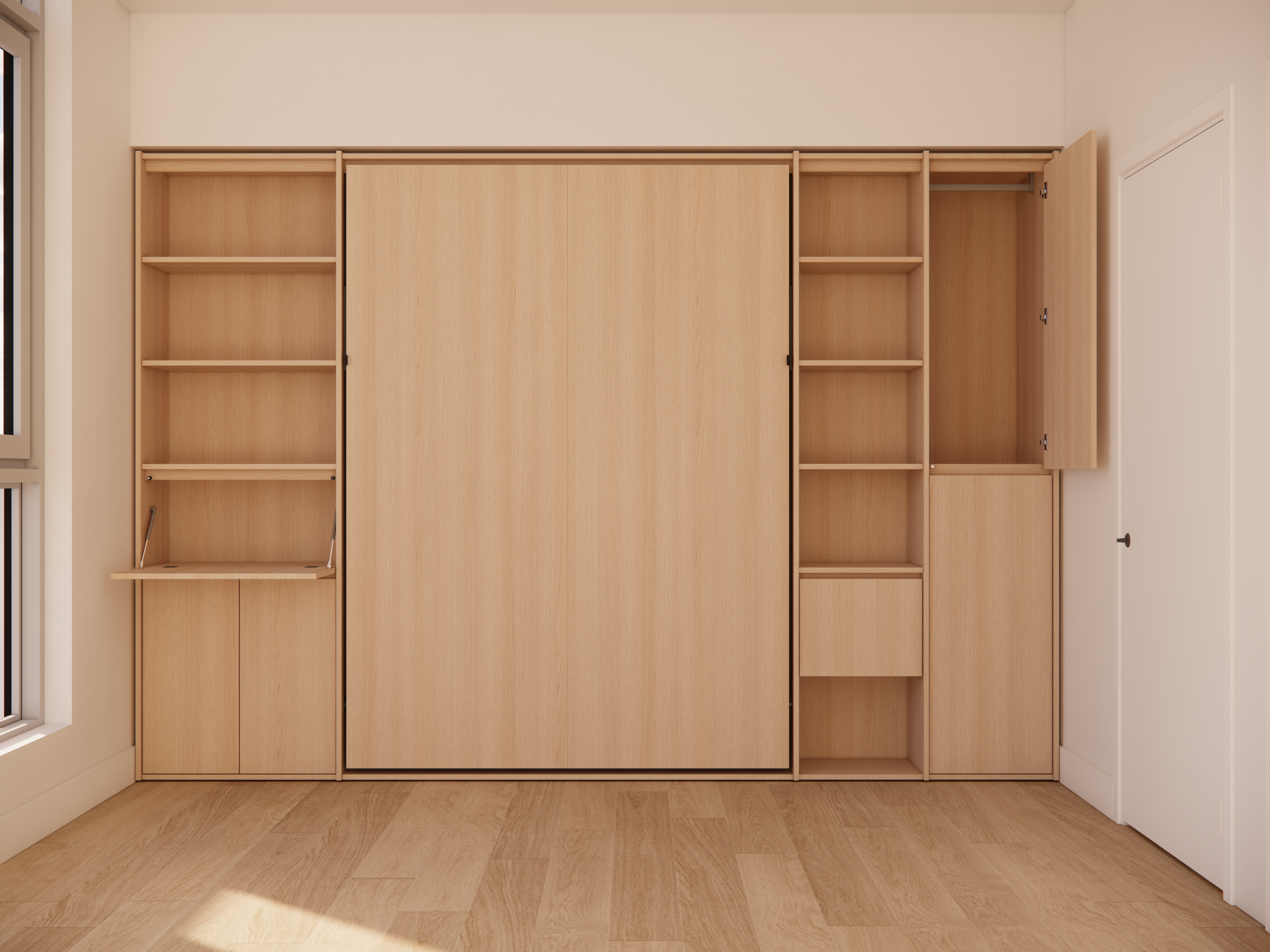
The Tekka Eddy was designed to do exactly this. The bed itself is a fully resolved piece of casework - engineered, calibrated, finished to architectural standards. But it is also part of a broader system. The same dimensional logic, the same material palette, and the same architectural language extend across more than fifty other units that combine with the Eddy to form complete walls.
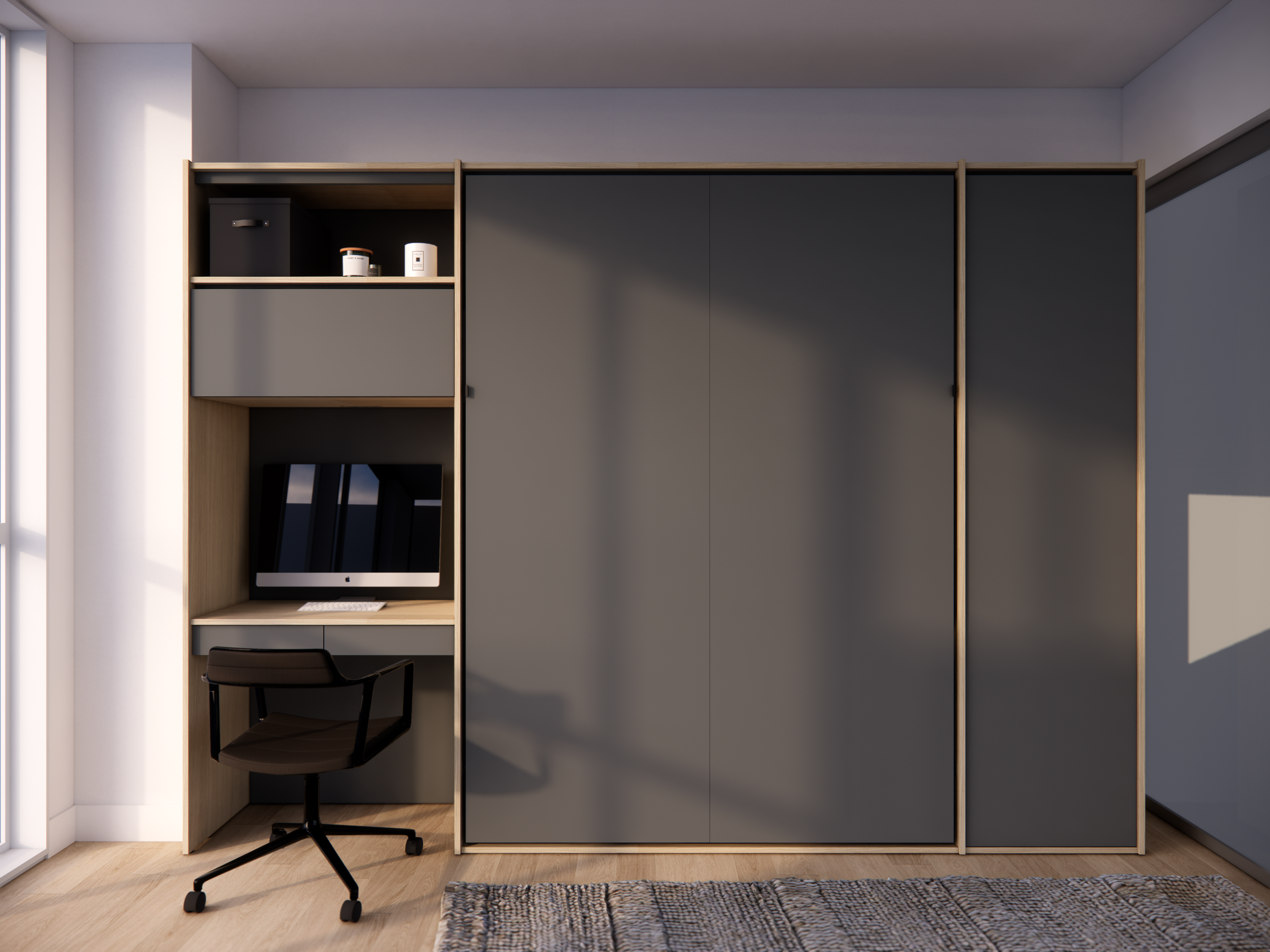
A wall bed with full-height wardrobes on either side. A wall bed with open shelving above and concealed storage flanking. A wall bed paired with a fold-down desk that converts the room into a home office during the day. A wall bed within a configuration that includes media storage, a reading bench, a workspace, and concealed everyday storage - all designed within a single coherent system, finished in a unified palette, by a single team.
This last configuration - wall bed plus integrated home office - has been one of our most-specified Tekka compositions for years. It is, in many ways, the platonic ideal of the wall bed concept: a room that is genuinely a home office most of the time, and genuinely a bedroom when needed, with no compromise on either function. The bed disappears. The desk emerges. The wall becomes whatever the day requires.
No other wall bed on the market is supported by a system designed to do this at scale. Most wall bed manufacturers treat the bed as the product. We treat the bed as one component of a larger architectural decision.
What this changes for the homeowner
If you are considering a wall bed for your home, the conversation you should be having is not just which wall bed do I buy. The more important question is what would the wall around this bed look like, if it were designed to support how I actually live?
The answer is rarely just a bed. It is usually a wardrobe, a workspace, a reading nook, a place for the things you live with. The Tekka Eddy makes those answers possible - not as add-ons, but as part of one continuous composition.
And the floor space that the bed used to occupy becomes available again. For working. For living. For everything you do during the hours you are not sleeping, which is most of them.
A home is the most personal thing you will ever design. A wall bed, when designed properly, returns square footage to your life. A wall bed designed within a system returns possibility.
Considering a wall bed for your home?
The Tekka Eddy is available in two depths and combines freely with the rest of the Tekka system across Storage, Work, Live, and Sleep categories. Visit our Vancouver showroom to operate one in person, or begin a conversation about how a wall bed configuration could resolve a room in your home.