Custom Millwork or Modular Furniture? A Plain Guide to Choosing
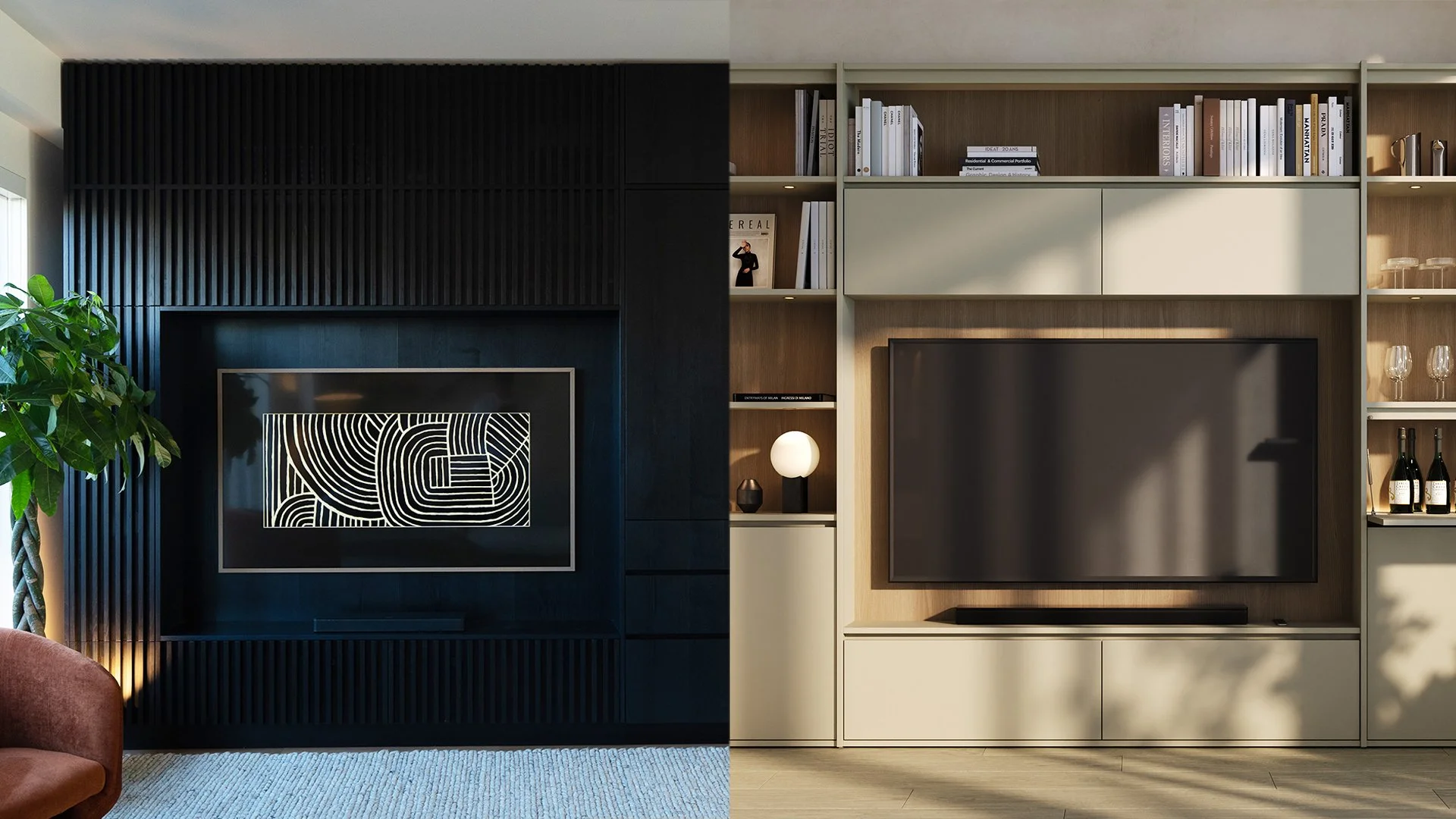
The trade-offs between fully custom built-ins, modular furniture systems, and freestanding pieces, and how to know which is right for your home.
If you're considering built-in furniture for your home - a media wall, a wardrobe, a home office, a Murphy bed, an entryway storage system, you're going to encounter three very different options, and the differences between them are not always obvious.
You can have something fully custom-made. You can buy a modular system like Tekka. Or you can buy freestanding furniture from a retailer and hope it fits the wall.
These are not just price tiers. They are genuinely different products, made in different ways, that produce different outcomes in your home. The right choice depends on what you actually want, and on understanding what each option does well, and what each one doesn't.
This is a plain guide to the choice.
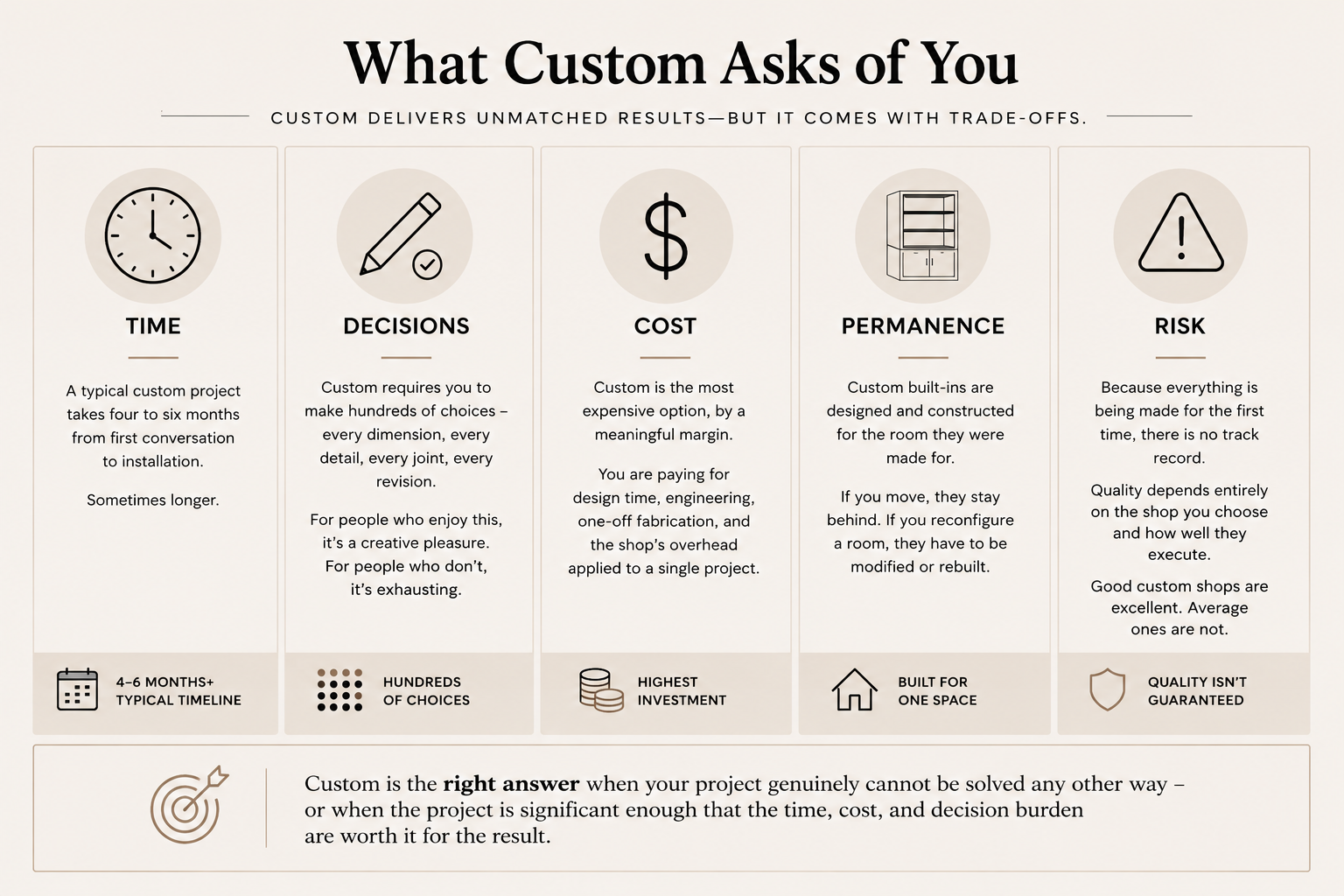
Option one - Fully custom millwork
A custom millwork project starts with a blank page. You work with a designer or directly with a fabrication shop. You develop drawings from scratch for your specific room, your specific dimensions, your specific needs. You select materials. You review shop drawings. You wait while the work is built. You schedule installation.
When it's done well, fully custom is the highest expression of built-in furniture. Every inch is designed around you. Every detail is yours.
What custom does well:
Resolves spaces that no system can - curved walls, complex geometries, unusual ceilings, heritage details
Accommodates highly specific needs - a collection of musical instruments, a wine cellar, a specialist workspace
Allows unlimited material choice, including stone, metal, glass, and rare woods
Produces something that is, in a real sense, one-of-a-kind
Option two - A modular system like Tekka
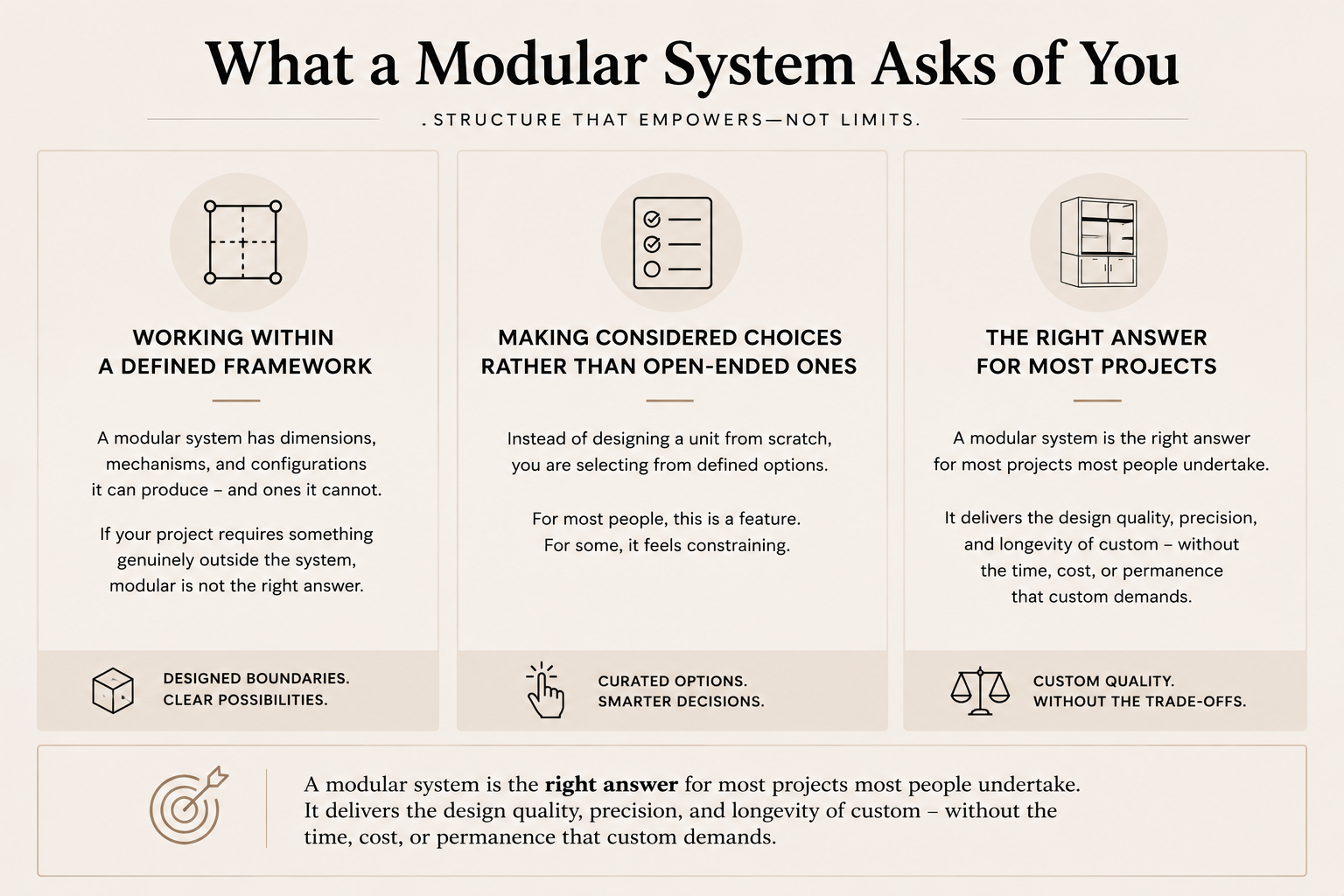
A modular system sits between custom and off-the-shelf. The system is designed once - carefully, by people who understand the problem deeply, and then configured to your specific space and needs.
In Tekka's case, the system was developed inside an architectural fabrication studio over more than a decade. Every unit has been refined through real installations. The dimensions, the materials, the hardware, the mechanisms - all of it has been resolved before you ever encounter it.
When you specify Tekka, you are not designing a piece of furniture from scratch. You are composing a configuration from a system that has already been designed.
What a modular system does well:
Delivers the precision and material quality of custom - to the millimetre, in real wood veneers and premium ultra-matte laminates
Resolves quickly - typically five to eight weeks from first conversation to installation, with initial design returned within forty-eight hours
Removes risk - because the system has been built hundreds of times, you know exactly what you are getting
Costs meaningfully less than custom - because the design work has already been done
Stays coherent across rooms - a media wall, a wardrobe, a home office, and a Murphy bed all read as one continuous design language
A modular system also does something custom millwork cannot: it moves with you.
Tekka is knockdown furniture - engineered to assemble cleanly from flat-pack components using a single 4mm hex key, and equally engineered to come apart again. If you move, your Tekka can come with you. The units disassemble, travel, and reinstall in a new space.
This matters more than people initially realize. Custom built-ins are permanent fixtures of the room they were made for. They are also significant investments. Watching a $40,000 custom millwork package stay behind when you sell the home is a real cost that doesn't appear in the original quote.
The same modularity changes how a Tekka system serves you over time. As your life changes - a guest room becomes a nursery, becomes a home office, becomes a teenager's bedroom - Tekka adapts. You can add new units to an existing configuration. You can move units to a different room. You can reconfigure a wall entirely as a space changes function.
A modular system, in other words, is not just an alternative to custom. It is a different relationship with your furniture. Custom asks you to commit to a single moment and a single room. Modular grows and shifts with the life being lived around it.
Option three - Freestanding furniture from a retailer
This is what most people default to. You go to a furniture store - online or in person - and buy what's available. A bookshelf. A wardrobe. A console table. You bring it home, assemble it, and put it against the wall.
There is nothing wrong with freestanding furniture for many situations. A side table, a sofa, a dining set - these are inherently freestanding pieces, and shopping for them at a retailer is the right approach.
What freestanding furniture does well:
Costs the least
Arrives the fastest
Requires no design process at all
Can be moved, rearranged, or replaced easily
What freestanding furniture is not designed to do:
Fit your space precisely. A retailer's bookshelf comes in three or four standard sizes. Your wall does not. You will have gaps, awkward leftover spaces, or filler pieces.
Resolve a wall as architecture. Freestanding pieces sit against a wall. Built-ins resolve a wall. The difference is subtle on the page and dramatic in the room.
Last decades. Most retail furniture is built to a price point. Particle board, thermofoil, basic hardware. Five years of use is often the practical limit before something starts to look tired.
Function as a unified system. A wardrobe from one retailer, a media console from another, and a desk from a third do not speak to each other. The room becomes a collection of furniture rather than a designed space.
Freestanding furniture is the right answer for the pieces that should genuinely move with you - and for early-life-stage homes where investment-grade built-ins are not yet appropriate. It is not the right answer when what you actually want is a wall that feels designed.
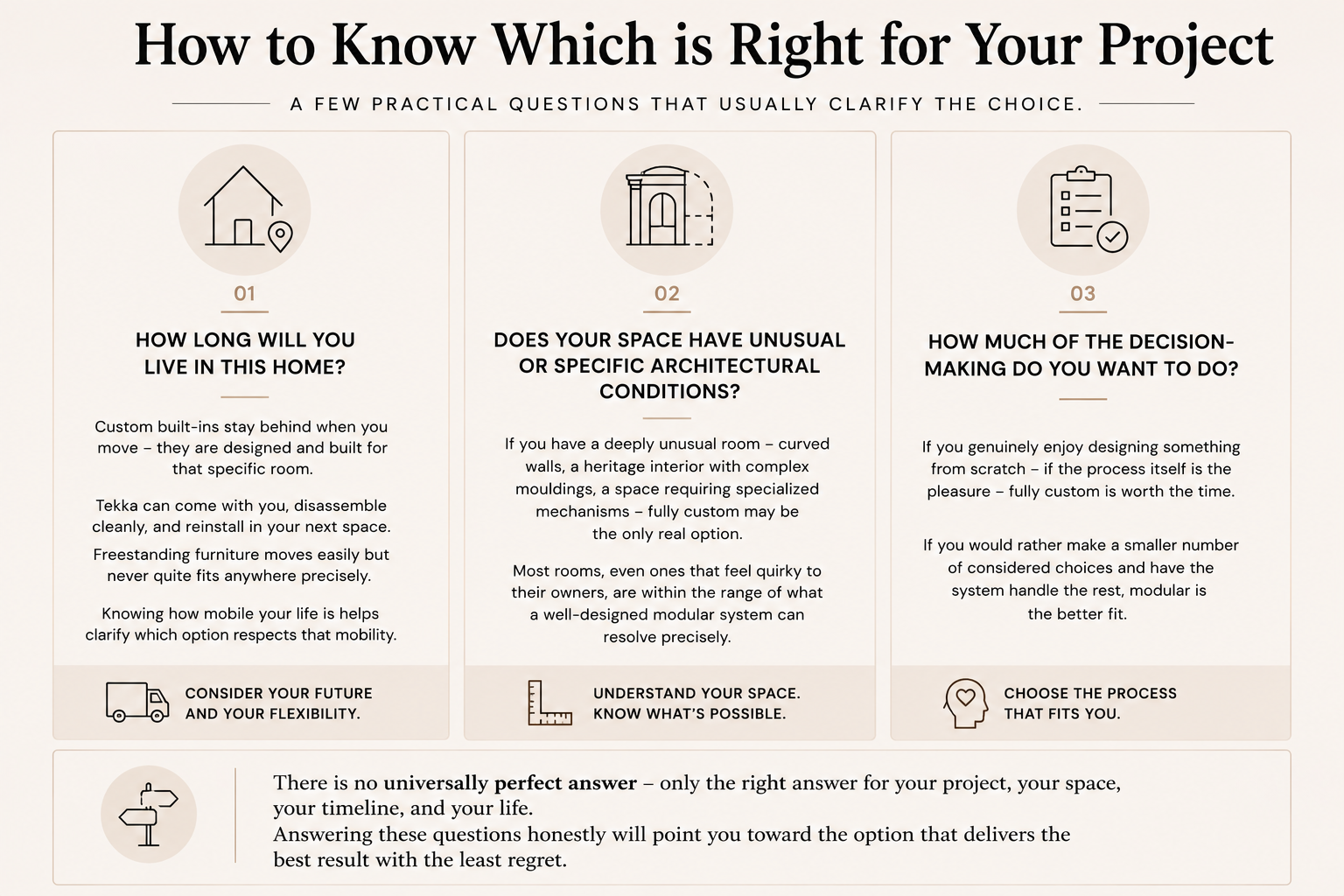
How important is design coherence across the home?
If you want a media wall in the living room, a wardrobe in the bedroom, and a home office in the den to read as one continuous design language, a modular system is the only practical way to achieve this. Custom can do it, but only if you commission all of them from the same shop at the same time, which most people don't.
Will your needs in this room change over time?
Children grow. Guest rooms become offices. Offices become studios. The room you furnish today is not necessarily the room you'll need in five years. A modular system can be reconfigured, added to, or repurposed as needs shift. Custom built-ins generally cannot.
What is the actual budget?
This is the question most people are too uncomfortable to ask plainly, so we'll ask it for them. Fully custom is the most expensive option, by a meaningful margin. A modular system like Tekka typically lands between thirty and fifty percent less than the equivalent custom package. Freestanding furniture is the least expensive option upfront - though as noted above, the lifetime cost is not always lower once replacement is factored in.
What we tell people who ask us directly
This is worth saying clearly: Anthill Studio, the studio that designed Tekka, is still a working custom millwork shop. We do both. When someone walks into our showroom or sends us a project brief, our job is to figure out which approach is genuinely right for them - not to push them toward Tekka because it's the product on the page.
Honestly, Tekka is the right answer for about eighty percent of the clients who come to us looking for custom built-ins. The system handles the wardrobes, media walls, home offices, Murphy beds, and integrated storage compositions that make up the bulk of what most people actually need. It delivers the design quality and the precision of custom, in less time, at a meaningfully lower price.
For the other twenty percent, custom is the better path - and we still build it. Kitchens. Complex geometries. Heritage interiors. Specialized millwork.
And sometimes the right answer is somewhere between the two. We frequently combine Tekka units with custom elements - a Tekka wardrobe and media wall paired with a custom built-in around a fireplace, or a Tekka home office integrated with a custom bench seat under a window. The system was designed by a custom shop, so it works seamlessly alongside custom work. The two are not mutually exclusive. Whatever the project genuinely needs, we have the tools to make it.
Beginning a conversation
If you're weighing options for a project in your home, we'd be happy to talk through what makes sense - including which combination of Tekka and custom is the right answer for your space.
Visit our showroom at 41 West 7th Avenue in Vancouver, or start a conversation about your space.